
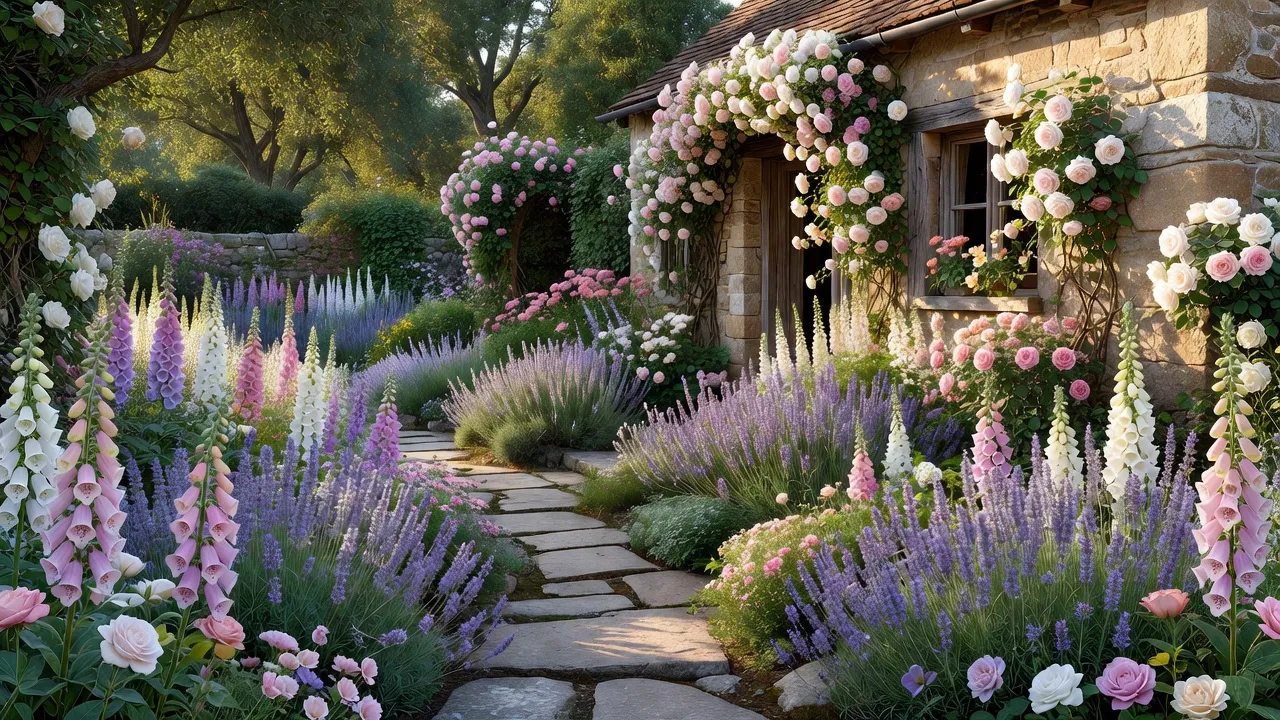
A cottage garden design plan relies on dense, multi-layered plantings of perennials, annuals, and shrubs organized along informal gravel paths rather than rigid geometric grids. Unlike formal landscapes that depend on clipped hedges and symmetrical lawns, a cottage layout mixes flowering species, edibles, and structural accents to maximize color, fragrance, and wildlife activity within a compact footprint.
Designing an authentic cottage space requires balancing visual spontaneity with underlying hardscape control. Without a clear structural framework, dense planting quickly turns into unmanageable clutter. Whether you are transforming a small suburban lawn or a sprawling rural backyard, establishing proper depth, plant proportions, and pathway boundaries ensures your garden remains healthy and visually balanced throughout the seasons.
To skip the guesswork of spatial planning, you can upload a photo of your existing yard to Renova AI to instantly preview exterior redesigns across various landscape styles. The iOS app on the Apple App Store allows you to visualize plant placement and structural hardscaping before buying materials or digging up turf.
What is the best layout for a cottage garden, including layers, structure, informal paths, and focal points?
The best layout for a cottage garden arranges plants into four distinct vertical height layers while steering foot traffic along winding stone or gravel pathways anchored by functional focal points. According to historical design records on Wikipedia, traditional cottage layouts originated as self-sustaining rural plots that prioritized functional density over rigid symmetry.
How do you layer plant heights from front to back?
Layering requires placing low-growing groundcovers along path edges, medium perennials in the mid-border, and tall background specimens against fences or walls.
- Foreground layer (0 to 1.5 feet): Border edges feature low creeping plants like sweet alyssum, bellflowers, creeping thyme, and cranesbill geraniums that spill gently over path boundaries.
- Midground layer (1.5 to 4 feet): The center zone contains structural perennials such as purple coneflowers, black-eyed Susans, foxgloves, and speedwell.
- Background layer (4 to 8+ feet): The back wall uses towering plants like delphiniums, hollyhocks, panicled hydrangeas, and climbing roses attached to wooden trellises.
- Canopy layer (8+ feet): Small ornamental trees like crabapples or serviceberries provide overhead shade and vertical balance.
How do informal paths guide garden movement?
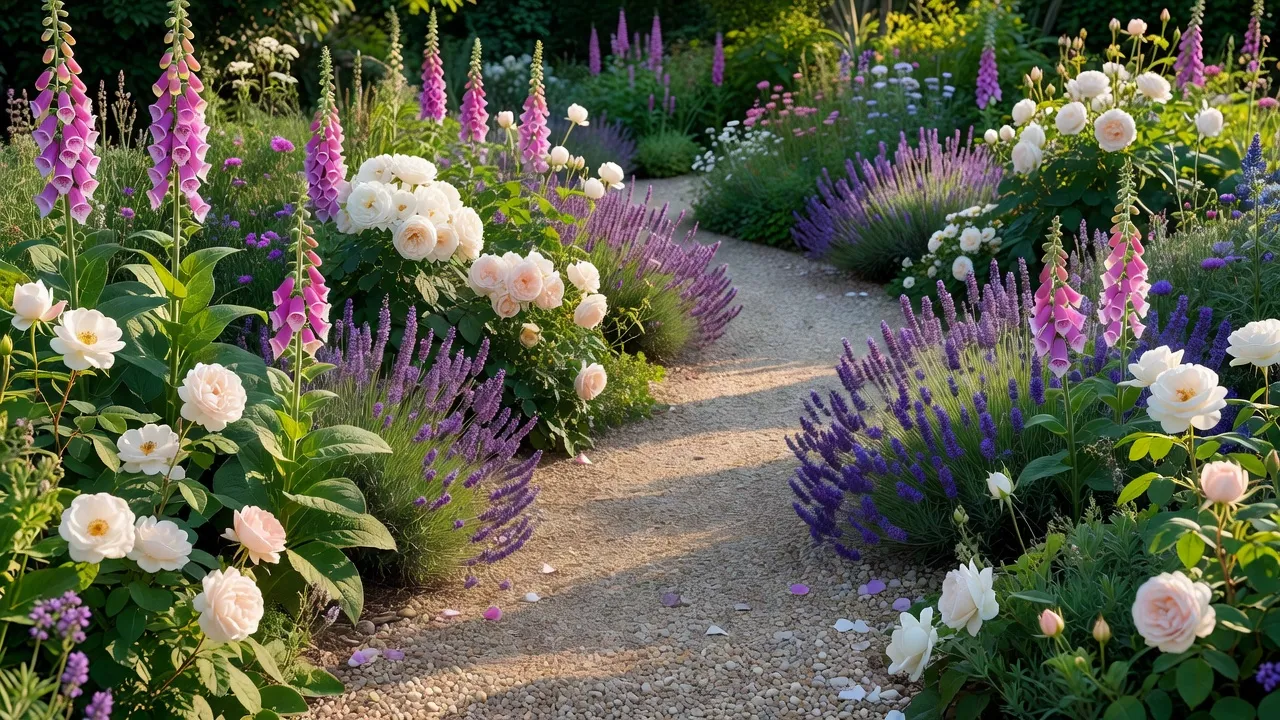
Informal paths should curve naturally through planting beds using loose materials like pea gravel, crushed granite, or weathered stepping stones. Paths ought to measure between 3 and 4 feet wide. This width allows two people to walk side-by-side while letting sprawling perennials overflow onto the walk without completely blocking passage.
What focal points work best in a cottage setting?
Classic cottage focal points include rustic wooden arbors, cast-iron birdbaths, antique weather-beaten benches, and rain barrels. Place these elements at the end of curving paths or hidden behind tall plant clusters. This creates visual surprises that encourage visitors to explore deeper into the yard.
What mix of perennials, annuals, and shrubs works best in a cottage garden?
The optimal cottage garden mix consists of roughly 50% herbaceous perennials, 30% flowering annuals, and 20% deciduous or evergreen shrubs. This specific ratio balances permanent winter structure with continuous summer flower production.
| Component | Percentage | Role |
|---|---|---|
| Herbaceous Perennials | 50% | Baseline structure & returning blooms |
| Self-Seeding Annuals | 30% | Filler color & seasonal variety |
| Structural Shrubs | 20% | Year-round framework & backbone |
Which perennials form the long-term backbone?
Long-lived perennials like peony, salvia, catmint, phlox, and oriental poppy deliver reliable seasonal blooms year after year. Perennials form the permanent architecture of your flower beds. Selecting species with staggered bloom schedules ensures continuous color from early spring through late autumn.
Why are self-seeding annuals necessary for authentic charm?
Self-seeding annuals like cosmos, zinnia, bachelor's buttons, and poppies fill open soil gaps and move naturally across borders each year. These fast-growing flowers prevent weeds from taking root. They also give the space its signature relaxed look by sprouting in unexpected path crevices.
What shrubs provide winter interest and height?
Structural shrubs like oakleaf hydrangea, boxwood, panicle hydrangea, and shrub roses prevent the garden from looking completely bare during winter. Evergreens positioned at bed corners establish permanent visual anchors when herbaceous plants die back after frost.
What are the best plant combinations for a cottage garden design?
The best plant combinations pair contrasting flower shapes and textures that bloom simultaneously under identical sun and soil conditions. Combining vertical flower spikes with broad button-shaped blooms creates visual tension that elevates simple flower borders.
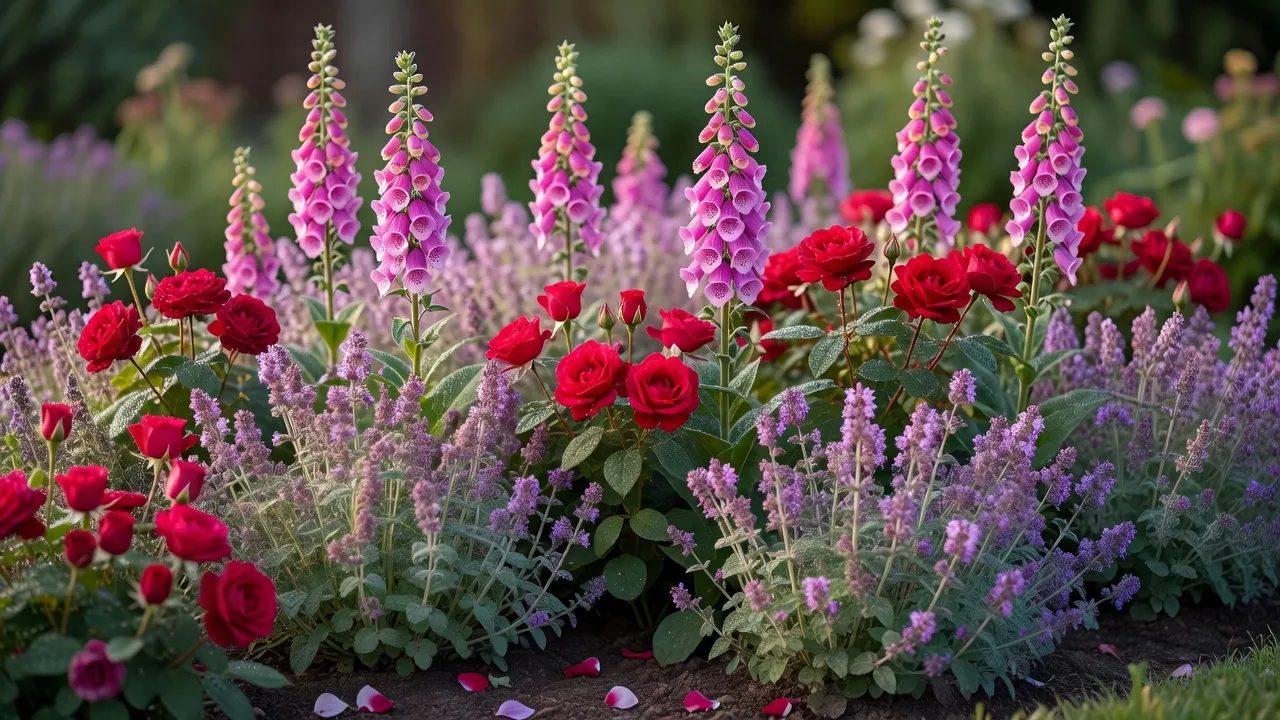
Classic sun-loving trio: Foxglove, Rose, and Catmint
Pairing tall vertical pink foxgloves with bushy red shrub roses and soft blue Nepeta (catmint) creates an iconic English cottage look. The spiky foxgloves break up the rounded form of the roses, while catmint carpets the bare lower stems of the rose bushes.
Pollinator-focused trio: Coneflower, Russian Sage, and Black-Eyed Susan
Combining purple coneflowers (Echinacea purpurea), airy Russian sage (Salvia yangii), and gold black-eyed Susans (Rudbeckia fulgida) provides non-stop summer blooms. This drought-tolerant group thrives in full sun and poor soil while attracting native bees and butterflies. For additional wildlife-focused layouts, explore our detailed butterfly garden design plan.
Cottage shade trio: Astilbe, Hosta, and Bleeding Heart
Combining feathery plumelike Astilbe, broad-leaved Hostas, and arching Bleeding Hearts (Dicentra spectabilis) brightens shaded areas under tree canopies. The broad foliage of Hostas contrasts sharply with the delicate fronds of fern-leaf bleeding hearts.
What design principles like naturalistic planting, pollinator-friendliness, and layering apply to cottage gardens?
Core cottage design principles prioritize drift-planting over single specimens, heavy reliance on nectar-rich blooms, and dense soil coverage to suppress weeds. Rather than spacing individual plants neatly in wood mulch, cottage style relies on overlapping plant foliage to create a living green carpet.
How does naturalistic drift planting work?
Drift planting places flowers in irregular, oblong groups of 3, 5, or 7 plants of the same species instead of straight rows. Planting in odd-numbered clusters mirrors natural seed dispersion in the wild. This technique creates sweeping bands of color that draw the eye smoothly across the yard.
How do you design for native pollinators?
Designing for pollinators requires choosing simple single-petal flower varieties where nectar and pollen are easily accessible. Avoid heavily bred double-petal cultivars that make access difficult for bees. Integrating native plants certified by regional agricultural extensions ensures reliable food sources for local species.
How does dense layering eliminate the need for synthetic mulch?
Dense foliage overlapping creates a green canopy that blocks sunlight from reaching buried weed seeds. As plants mature, their leaves shield the ground. Moisture stays trapped in the topsoil naturally, reducing irrigation needs and replacing annual bark mulch applications.
What are current trends in cottage garden design?
Current trends favor replacing high-maintenance lawns with drought-tolerant native plants, climate-resilient perennials, and integrated edible crops. Recent updates to the USDA Plant Hardiness Zone Map highlight shifting temperature zones across North America. As a result, growers are pivoting toward resilient landscaping strategies.
- Climate-resilient species: Gardeners are replacing traditional moisture-loving plants with drought-tolerant options like yarrow, agastache, and sea holly.
- Lawn-to-cottage conversions: Homeowners are turning water-thirsty front lawns into dense, productive flower and herb borders to boost landscape for curb appeal.
- Edible Integration: Mixing heirloom tomatoes, kale, berry bushes, and edible flowers directly into ornamental beds has replaced isolated vegetable patches.
- Rewilding and habitat preservation: Leaving seed heads intact through late fall provides essential winter food and shelter for songbirds and beneficial insects.
Cottage garden design plans for 5 specific yard scenarios
Tailoring a cottage layout to your specific site conditions ensures plants thrive without excessive chemical interventions or continuous manual corrections. The following five scenarios cover common residential yard challenges and detail exact planting strategies for each space.
Yard Scenarios Overview
- Micro Suburban Side Yards (Narrow spaces & hardscape borders)
- Sloped Yards & Hillsides (Terraced stone retaining beds)
- Drought-Prone Regions (Xeriscape & low-water perennials)
- Shady Urban Lots (Part-shade foliage & woodland species)
- Productive Backyard Spaces (Integrated potager & edible beds)
1. Best for small suburban side yards: The micro-cottage border
Small suburban side yards benefit from narrow vertical borders focused on trellis-trained climbers and compact dwarf perennials. Side yards often suffer from narrow footprints bounded by privacy fences or neighbor walls.
Focus plant selection on vertical space. Use climbing hydrangeas, clematis, and dwarf delphiniums along fence lines. Keep walkways clear by installing stone pavers edged with low-sprawling thyme.
If you are unsure how structural trellises or tall borders will frame your home, testing layout variations through digital garden design services helps clarify proportions before installation.
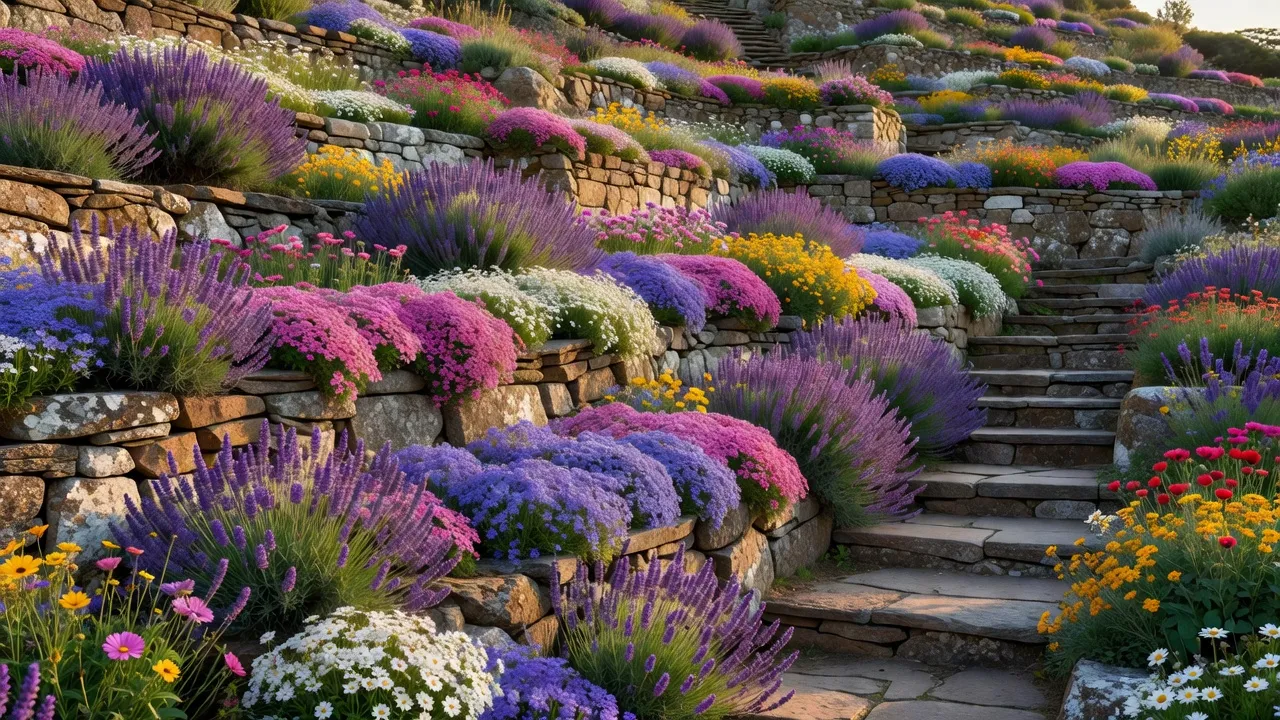
2. Best for sloped yards and hillsides: The terraced cottage garden
Sloped yards perform best when broken into flat terraced beds using dry-stacked fieldstone retaining walls filled with cascading perennials. Slopes often suffer from rapid soil erosion and water runoff.
Stacking natural stone walls creates flat planting pockets that trap rainfall. Plant trailing flowers like creeping phlox, aubrieta, and stonecrop along stone edges to spill over wall faces. Fill upper terrace levels with deep-rooting shrubs like rugosa roses and dwarf conifers to stabilize soil banks.
3. Best for drought-prone regions: The climate-resilient cottage plot
Drought-prone yards achieve a classic cottage look by substituting water-heavy traditional flowers with grey-foliage Mediterranean herbs and native prairie wildflowers. Hot climates burn through traditional cottage species like delphiniums and hydrangeas.
Replace high-water choices with drought-tolerant alternatives:
- Swap English lavender for Spanish lavender or blue giant hyssop (Agastache).
- Swap traditional roses for drought-hardy garden design with roses using rugosa hybrids or native shrub species.
- Swap hostas for silver-foliaged wormwood (Artemisia), lamb's ear, and Russian sage.
Denser plantings shield soil from direct sunlight, reducing evaporation losses across hot summer months.
4. Best for shady urban lots: The woodland cottage sanctuary
Shady urban spaces enclosed by tall buildings or mature trees require moisture-retentive woodland plants with varied leaf textures and bright flowers. Full sun is rare in urban pockets, but partial shade offers ideal conditions for rich foliage gardens.
Anchor shady borders with bigleaf hydrangeas, coral bells (Heuchera), Japanese forest grass, and woodland ferns. Use white-flowering species like goat's beard (Aruncus dioicus) and white bleeding hearts to bounce ambient shade light into dark corners.
5. Best for productive backyard spaces: The edible cottage kitchen garden
Edible cottage spaces interplant vegetables, herbs, and fruit trees directly among ornamental flowers in an informal layout. Traditional vegetable patches rely on strict, isolated rows. An edible cottage plot mixes crops together.
Plant curly kale alongside purple salvia, frame heirloom tomatoes with orange marigolds to deter pests, and edge pathways with low-growing strawberries and curly parsley. This biodiversity reduces pest outbreaks by disrupting monoculture feeding habits.
Comparing cottage garden design strategies by yard scenario
Evaluating yard scenarios alongside structural needs, realistic budgets, and plant selections helps identify the correct approach for your property. The table below compares the five core cottage scenarios:
| Yard Scenario | Primary Spatial Challenge | Key Structural Needs | Plant Selection Focus | Realistic Cost Range | Renova AI Visualization Fit |
|---|---|---|---|---|---|
| Renova AI Digital Planning | Spatial layout uncertainty & visual planning | Photo-based AI rendering engine | Instant preview of 100+ style layouts | No manual editing required | Ideal first step for testing all yard scenarios before ground disturbance |
| Micro Side Yard | Narrow width & tall boundary walls | Vertical trellises & narrow paver paths | Dwarf perennials, clematis, creeping thyme | $500 – $1,500 | High (previews vertical fence planting & path boundaries) |
| Sloped Hillside | Soil erosion & fast moisture runoff | Dry-stacked stone terraces & steps | Deep-rooting shrubs, cascading stonecrop | $2,500 – $7,000 | High (simulates terraced stone walls & multi-level layouts) |
| Drought-Prone Plot | Intense heat & water restrictions | Deep gravel mulching & drip lines | Mediterranean herbs, agastache, native coneflowers | $1,000 – $3,000 | High (previews dry-gravel borders & drought-tolerant foliage) |
| Shady Urban Lot | Low light levels & poor circulation | Raised beds & ambient light surfaces | Hostas, ferns, coral bells, white astilbe | $800 – $2,500 | Medium (visualizes shadow-friendly plant density) |
| Edible Kitchen Garden | Balancing production with aesthetics | Obelisk supports & compost beds | Heirloom crops, marigolds, kale, fruit shrubs | $600 – $2,000 | High (previews mixed vegetable and floral border layouts) |
How to build your cottage garden step-by-step
Building a functional cottage garden requires systematically preparing soil, installing hardscape boundaries, placing backbone plants, and filling open soil gaps. Following a structured installation timeline prevents costly plant losses and material waste.
Step 1: Map layout boundaries and remove existing turf
Mark out curving pathway borders using flexible garden hoses or spray paint before stripping existing grass. Remove sod with a flat spade or smother grass using sheet mulching (cardboard topped with organic compost).
According to horticultural guidelines from the Penn State Extension, adding 2 to 3 inches of organic matter into native soil improves drainage in heavy clay while boosting water retention in sandy soils.
Step 2: Lay down informal hardscape pathways
Install your chosen path materials before putting any plants into the ground. Dig out paths to a depth of 4 inches, line the trench with woven landscape fabric to stop weeds, fill with 3 inches of crushed stone base, and top with 1 inch of pea gravel or stepping stones. Completing heavy construction first avoids damaging fragile root systems later.
Pathway Layers Breakdown
| Layer | Depth | Material |
|---|---|---|
| Top Layer | 1" | Pea Gravel or Stepping Stones |
| Base Layer | 3" | Crushed Stone Aggregate |
| Separation Barrier | Woven Landscape Fabric | |
| Excavated Subsoil Trench | 4" |
The layers are arranged from top to bottom in this order.
Step 3: Position background shrubs and vertical focal points
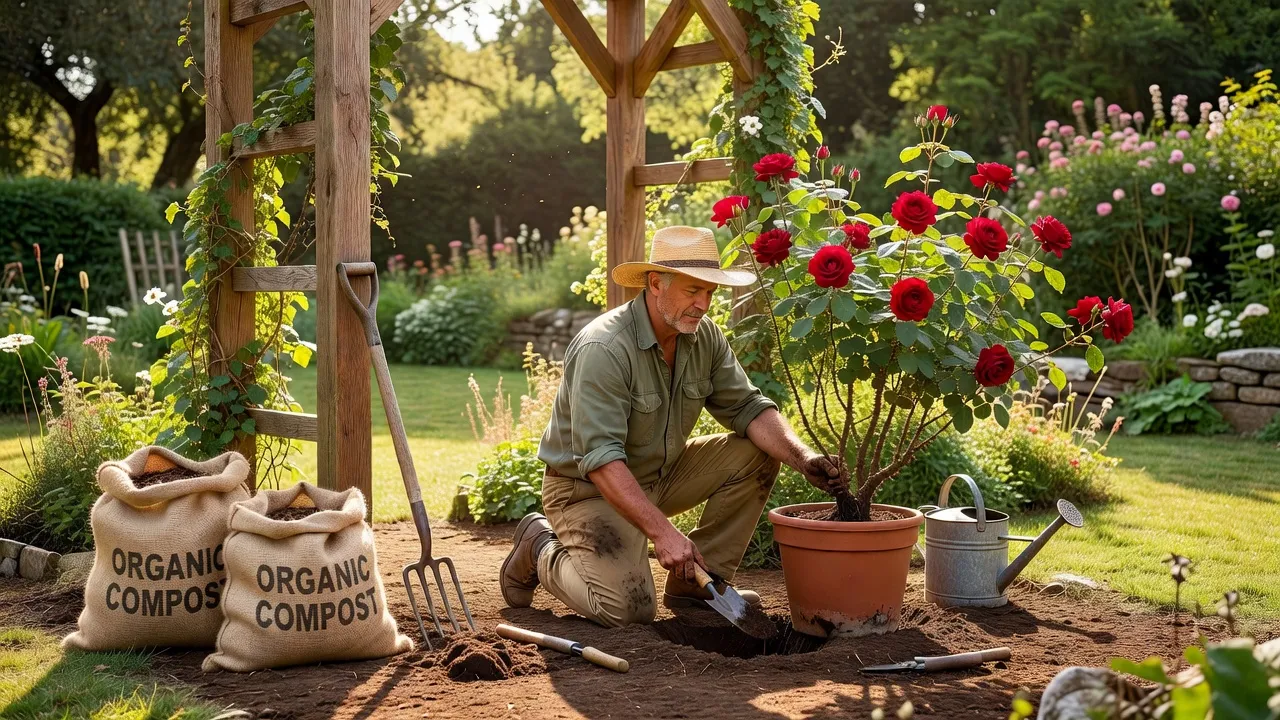
Set mature shrubs, arbors, and background trellises into place first to establish the garden's structural framework. Dig planting holes twice as wide as the root ball but at the exact same depth as the nursery container. Water thoroughly immediately after backfilling to eliminate air pockets around roots.
Step 4: Group midground perennials and fill groundcover gaps
Arrange midground perennials in odd-numbered clusters and complete the space with self-seeding annuals and groundcovers. Space plants based on their mature spread rather than their nursery size. Fill bare soil between young plants with annual seeds to keep weeds under control while perennials mature over their first two seasons.
Frequently Asked Questions
How do I stop a cottage garden from looking messy?
Maintain clear hardscape boundaries, trim crisp lawn edges, and keep pea gravel paths weed-free. Structural items like wooden arbors, stone walls, or neat hedges anchor visual clutter, making dense flower beds look intentional rather than overgrown.
Are cottage gardens high maintenance?
They require higher maintenance during the first two years for weeding and establishment, but maintenance drops as plants mature. Once foliage covers open soil, dense borders block weeds and retain moisture, cutting down on manual weeding and mulching.
Can I design a cottage garden in full shade?
Yes, using shade-tolerant plants like hostas, ferns, astilbe, foxgloves, and coral bells. Focus on combining rich leaf textures, varied greens, and light-colored blooms to brighten dark, shaded areas under trees or tall walls.
How wide should cottage garden borders be?
Cottage borders perform best at 4 to 6 feet wide. This depth allows enough room for three distinct plant height layers—foreground groundcovers, midground perennials, and background shrubs—without crowding plant roots.
What is the difference between an English garden and a cottage garden?
English estate gardens rely on grand vistas, manicured lawns, clipped boxwood hedges, and symmetrical geometry. Cottage gardens are informal, compact, densely planted, and traditionally mix edible crops, herbs, and flowers together.
How long does it take for a cottage garden to establish?
Perennial cottage gardens usually take three full growing seasons to mature. Year one focuses on root establishment, year two brings steady growth, and by year three plants fill out to eliminate open soil gaps.
Can I build a cottage garden on a low budget?
Yes, by starting with self-seeding annual seeds, swapping plant divisions with neighbors, and using low-cost hardscape materials like crushed pea gravel or salvaged bricks. Starting perennials from bare roots or winter seeds cuts material expenses significantly.