
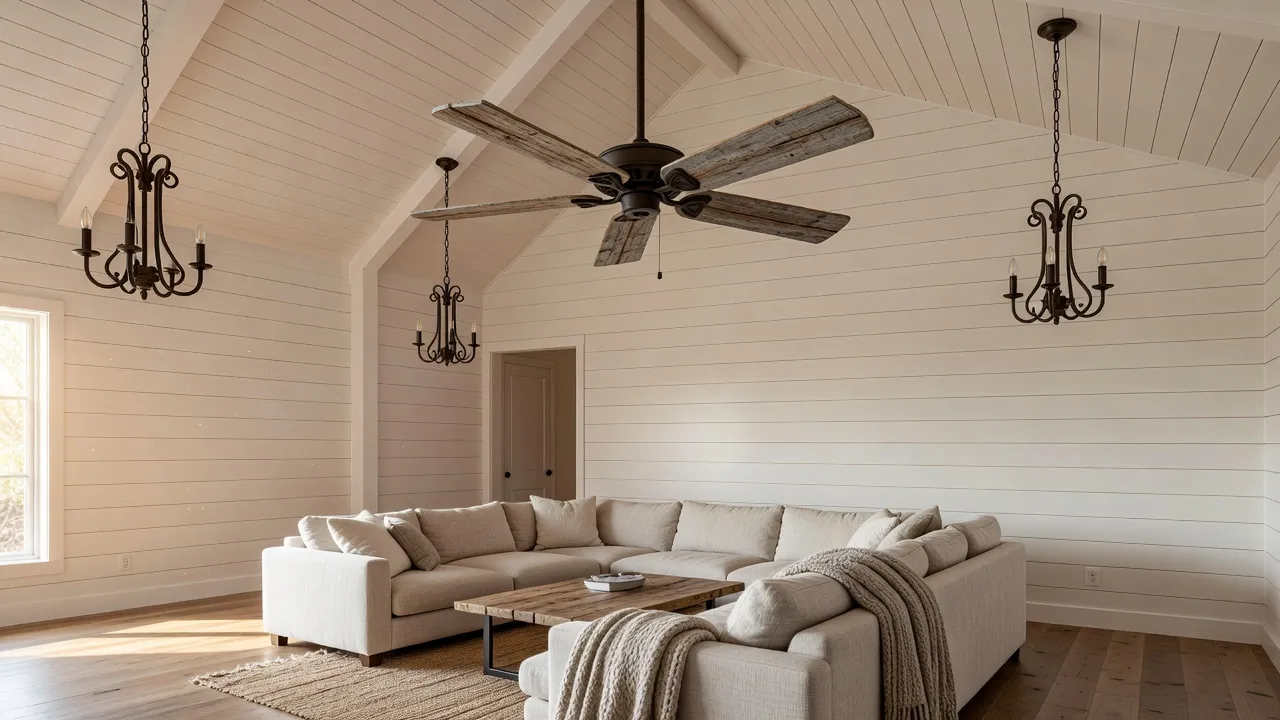
For most living rooms and bedrooms, the best farmhouse style ceiling fans feature 52-inch reversible blades in barnwood or driftwood finishes, black iron or brushed nickel metalwork, and an integrated LED caged or seeded glass light kit. Top-rated options like the Hunter Mill Valley and Hampton Bay Southwind lead the market by delivering quiet airflow above 4,000 CFM while matching modern rustic, coastal, and industrial interior aesthetics.
Choosing the right rustic fixture involves evaluating airflow ratings, blade span, ceiling clearance, and motor efficiency. Installing an ill-fitted fan can result in noisy operation or poor air circulation, making pre-purchase planning essential.
What is the best-selling Hampton Bay farmhouse ceiling fan?
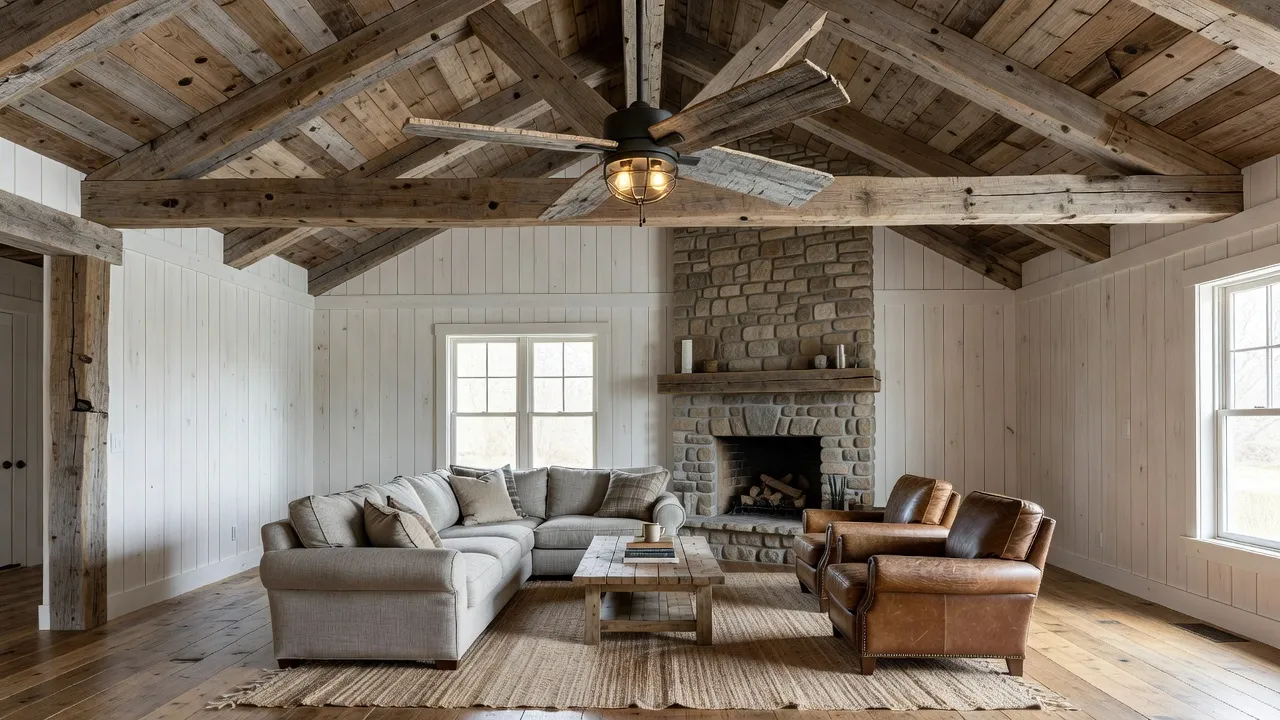
The best-selling Hampton Bay farmhouse ceiling fan is the Southwind 52-inch Matte White or Brushed Nickel Ceiling Fan. This model consistently tops sales charts at major home improvement retailers due to its balance of rustic visual charm, reversible driftwood blades, and an affordable price point under $150.
Hampton Bay Southwind 52-in Fast Facts:
- Airflow Capacity: ~4,500 CFM
- Motor Type: 3-Speed AC Motor
- Blade Finishes: Reversible Driftwood / Matte White
- Lighting: Integrated Frosted Glass Bowl (LED Compatible)
- Control: Included Remote Control
Homeowners favor the Southwind because it adapts easily to both classic rustic spaces and contemporary ranch homes. According to specification listings on Home Depot, the fixture includes a multi-position mounting system that accommodates flat, angled, or low ceilings. Its reversible motor lets you switch between downward summer cooling and upward winter warm-air recirculation with the slide of a switch.
What is the most popular farmhouse style ceiling fan with a light?
The most popular farmhouse style ceiling fan with a light is the Hunter Mill Valley 52-inch Indoor/Outdoor Ceiling Fan. Featuring a distinctive industrial hood light, exposed rivets, and rustic vintage finish options, this fixture dominates customer review rankings for aesthetic appeal and light output.
Hunter Mill Valley 52-in Fast Facts:
- Airflow Capacity: 4,403 CFM
- Motor Type: WhisperWind Reversible AC Motor
- Blade Finishes: Matte Black with Walnut / Burnt Walnut Blades
- Damp Rating: ETL Damp-Rated (Suitable for Covered Porches)
- Lighting: Vintage LED Edison Bulb inside Industrial Hood
The Mill Valley stands out because it combines functional illumination with authentic barn-style hardware. Official documentation on Hunter Fan Company notes that its WhisperWind motor delivers powerful air movement without the humming noise common in cheaper ceiling fixtures. The included dimmable LED Edison bulb generates warm ambient lighting while consuming under 10 watts of energy.
The Best Farmhouse Style Ceiling Fans for 2026
To select the right farmhouse style ceiling fan, you must compare blade materials, motor technology, noise levels, and total operating costs. Below is a head-to-head breakdown of top options alongside digital planning tools.
| Fan / Solution Model | Best For | Blade Span | CFM Airflow | Motor Type | Estimated Price |
|---|---|---|---|---|---|
| Renova AI Visualizer | Room Layout & Design Preview | N/A | N/A | Digital AI | Free (Paid $6.99/wk) |
| Hunter Mill Valley | Covered Porches & Great Rooms | 52 inches | 4,403 CFM | AC WhisperWind | $220 - $260 |
| Hampton Bay Southwind | Budget-Conscious Living Rooms | 52 inches | 4,500 CFM | 3-Speed AC | $130 - $150 |
| Honeywell Carnegie | Industrial Farmhouse Aesthetics | 52 inches | 4,621 CFM | Reversible AC | $140 - $170 |
| Harbor Breeze Mazon | Low Ceiling / Flush Mount Rooms | 44 inches | 2,845 CFM | 3-Speed AC | $100 - $120 |
| Big Ass Fans Haiku Wood | Premium Smart Efficiency | 52–60 inches | 5,600+ CFM | Ultra-Quiet DC | $900 - $1,200 |
How do you preview a farmhouse style ceiling fan in your room before buying?
You can preview how a farmhouse style ceiling fan looks in your exact room by uploading a smartphone photo to the Renova AI app. The artificial intelligence renders rustic light fixtures, wood finishes, and altered ceiling layouts in seconds so you do not install the wrong fixture size or color tone.
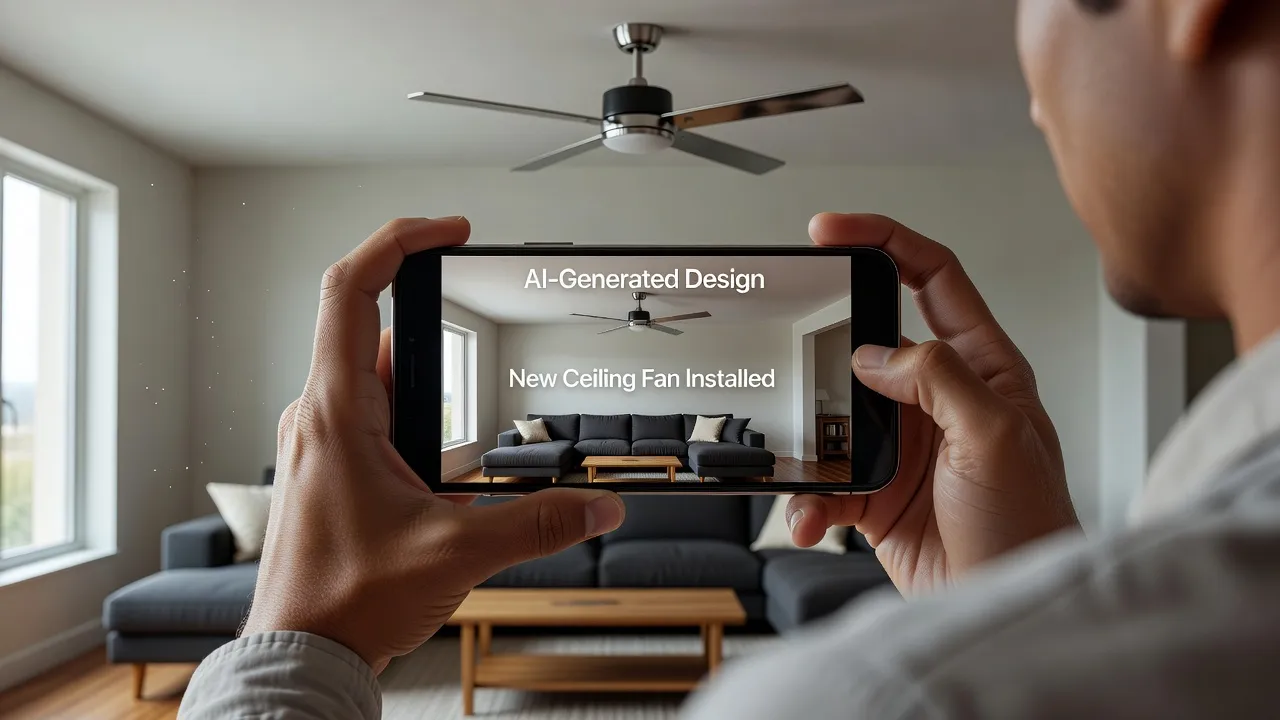
Installing a ceiling fan requires electrical wiring, downrod trimming, and ceiling anchoring. Testing scale and blade finish beforehand prevents costly return hassles.
- Snap a photo: Take a clear picture of your bedroom, porch, or living room ceiling in natural light.
- Select Farmhouse style: Choose rustic, country, or modern farmhouse from over 100 selectable style options.
- Review instant renders: View your remodeled space with updated fixtures, floor textures, and wall colors without doing manual photo editing.
Trying out interior configurations using tools for farmhouse design ensures that dark iron cages or heavy oak blades will not overpower your room's natural lighting or existing wall paint.
5 Top Farmhouse Style Ceiling Fans Reviewed
1. Hunter Mill Valley 52-Inch Damp-Rated Fan
The Hunter Mill Valley is the top overall choice for homeowners seeking authentic barn-style architecture. Its galvanized metal or matte black housing paired with burnt walnut blades creates an undeniable rustic focal point.
- Pros: ETL damp rating allows outdoor porch use; whisper-quiet motor performance; clear industrial aesthetic.
- Cons: Industrial hood shade focuses light downward rather than washing the entire room in light.
- Trade-off: You trade broad ceiling light distribution for striking directional vintage illumination.
2. Hampton Bay Southwind 52-Inch Ceiling Fan
The Hampton Bay Southwind delivers the best overall monetary value for indoor living areas. As of September 2026, it remains one of the most cost-effective 52-inch fans featuring remote control operation out of the box.
- Pros: Extremely affordable price under $150; reversible blades match lighter or darker flooring; easy installation.
- Cons: Indoor-only rating limits porch usage; plastic remote receiver can be tight to fit inside the canopy during installation.
- Trade-off: You save significantly on upfront purchase costs, but lose weather-resistant damp protection.
3. Honeywell Carnegie 52-Inch Industrial Farmhouse Fan
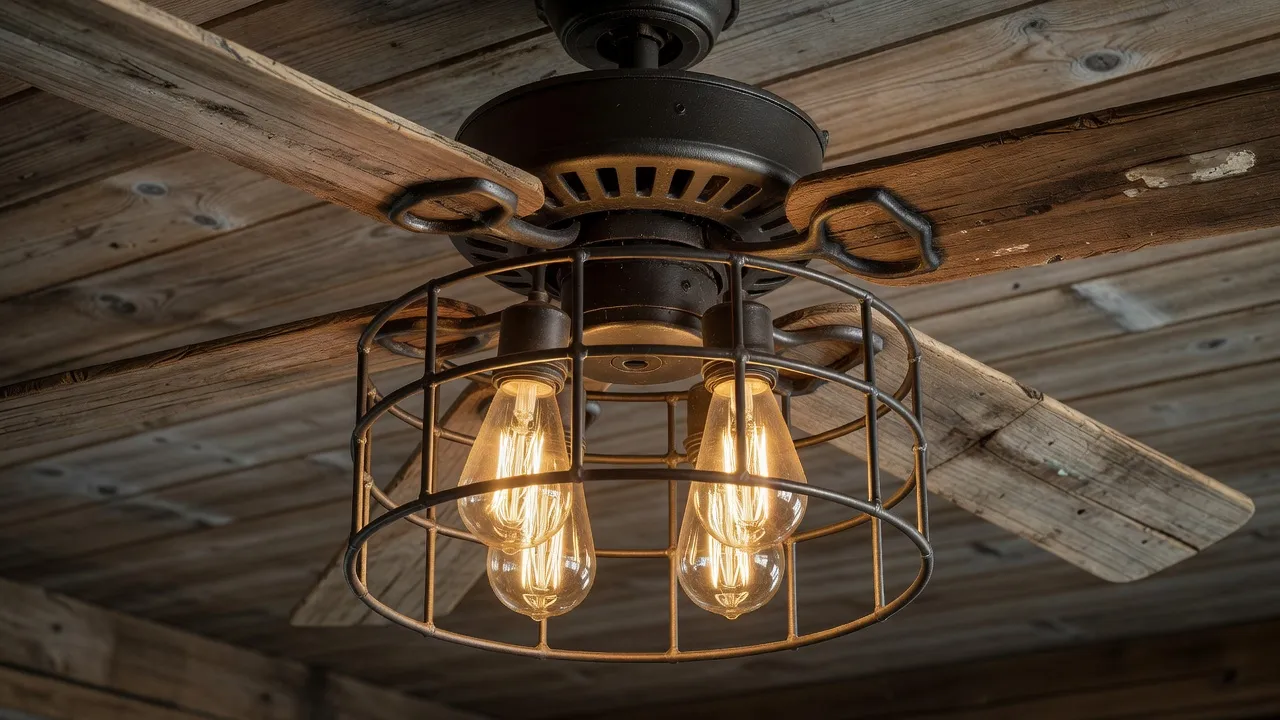
The Honeywell Carnegie offers a dual-finish blade design that fits modern rustic and industrial spaces. Featuring a cage light housing with three exposed LED Edison bulbs, it delivers ample ambient illumination.
- Pros: Excellent light dispersion; bold iron mesh cage design; high airflow rating above 4,600 CFM.
- Cons: Bulb changes require unscrewing small cage hardware; motor housing sits lower than basic flush mounts.
- Trade-off: High aesthetic impact comes with slightly trickier bulb maintenance down the road.
4. Harbor Breeze Mazon 44-Inch Flush Mount Fan
The Harbor Breeze Mazon is the premier choice for low-ceiling farmhouses and small bedrooms. Its hugger mounting design mounts directly against drywall ceilings without requiring a downrod.
- Pros: Perfect 14-inch total profile height; integrated 18-watt LED panel; compact footprint fits 10x10 foot rooms.
- Cons: Fixed 44-inch blade span is too small for large great rooms; modern sleek look leans subtle on rustic details.
- Trade-off: You gain crucial head clearance in 8-foot rooms, but sacrifice dramatic open-blade style.
5. Big Ass Fans Haiku Rustic Walnut DC Motor Fan
The Haiku Rustic Walnut fan represents the high-end luxury tier of farmhouse ventilation. Driven by an ultra-efficient DC motor, it uses less energy than a standard 10-watt LED bulb while moving massive volumes of air.
- Pros: Unmatched energy efficiency; silent brushless motor; hand-crafted sustainable aircraft-grade aluminum with wood finishes.
- Cons: Premium price point approaching $1,000; requires dedicated app setup for advanced smart features.
- Trade-off: High upfront investment pays off in silent operation and modern smart home integration.
What key specs should you check before buying a farmhouse style ceiling fan?
Before buying a farmhouse ceiling fan, you must verify room square footage, ceiling height, CFM airflow efficiency, motor type, and lighting output. Checking these specs prevents wobble, motor humming, and insufficient cooling performance.
Quick Ceiling Fan Sizing Guidelines:
- Small Rooms (up to 100 sq ft): 36 to 44 inches
- Medium Rooms (100 - 225 sq ft): 52 inches
- Large Rooms (225 - 400 sq ft): 56 to 60 inches
- Great Rooms (400+ sq ft): 60+ inches or Dual Fans
Airflow Efficiency (CFM)
Cubic Feet per Minute (CFM) measures how much air a fan moves at high speed. The U.S. Department of Energy recommends choosing fans that generate at least 4,000 CFM for standard living spaces to ensure effective air circulation without wasteful power draw.
AC vs. DC Motors
- AC Motors: Standard AC motors are budget-friendly and offer 3-speed operation via wall switch or pull chain.
- DC Motors: Direct Current (DC) motors consume up to 70% less electricity, run completely silent, and typically offer 6 speed options.
Downrod Length and Ceiling Clearance
For safety and proper airflow, fan blades must sit at least 7 feet above the floor. If you have a vaulted ceiling in a ranch style farmhouse, you will need to purchase an extended downrod separately.
Recommended Downrod Lengths by Ceiling Height:
- 8-Foot Ceiling: Flush Mount / Hugger (No Downrod)
- 9-Foot Ceiling: 6-Inch Downrod
- 10-Foot Ceiling: 12-Inch Downrod
- 12-Foot Ceiling: 24-Inch Downrod
- 14-Foot Ceiling: 36-Inch Downrod
How do you style a farmhouse ceiling fan with existing room decor?
To style a farmhouse ceiling fan, match the fan's metal hardware to your cabinet knobs and align blade wood tones with your hardwood flooring or trim. Combining rustic textures creates a cohesive visual rhythm throughout open-concept living quarters.
Farmhouse Finishes Pairing Chart:
- Modern Farmhouse: Matte Black Iron Hardware + Light Driftwood Blades
- Classic Country Farmhouse: Antique Bronze Hardware + Warm Cherry/Walnut Blades
- Industrial Rustic: Brushed Nickel / Galvanized Steel + Weathered Gray Blades
- Coastal Farmhouse: Pure Matte White + Natural Distressed Pine Blades
If your home features dark ceiling beams, choose fan blades in a complementary stain rather than an exact black paint. This avoids heavy dark blobs on the ceiling.
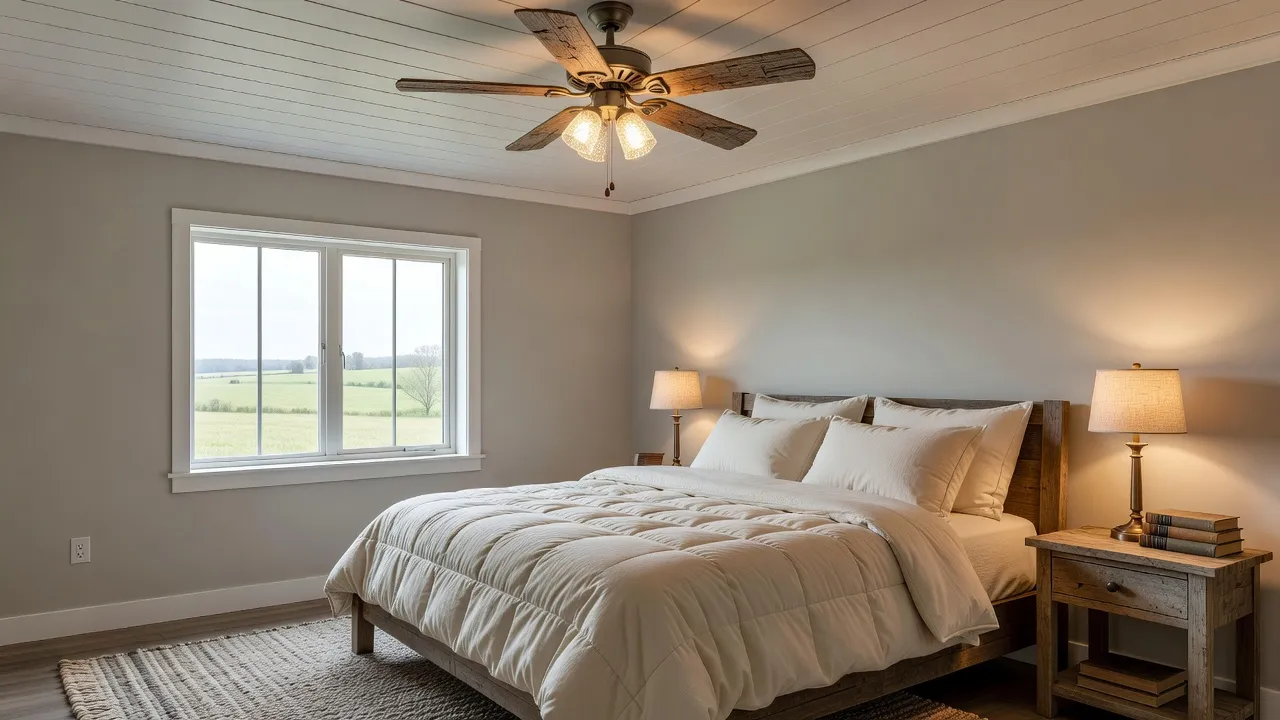
Adding layered elements like rustic rugs and textured wall finishes enhances the cozy feel. Pairing your new lighting fixture with contextual wall ideas, such as wood shiplap or complementary paint shades, ties the room together. When coordinating larger interior updates, incorporating curated farmhouse style decorations keeps the space from looking cluttered.
What is the true cost of purchasing and installing a farmhouse ceiling fan?
The total cost to purchase and install a farmhouse ceiling fan ranges between $180 and $650, depending on fan features and electrical complexity.
Detailed Cost Breakdown (2026 Pricing):
- Basic Fan Purchase: $100 - $300
- Premium / Smart Fan Purchase: $400 - $1,000
- Standard Professional Electrician Installation: $150 - $250
- New Wiring & Switch Box Setup (if no fixture exists): $200 - $400
- Extended Downrod / Sloped Ceiling Kit: $25 - $60
Hidden Installation Expenses to Watch For
- Unsupported Junction Boxes: Standard plastic light fixture boxes cannot handle ceiling fan weight and motion torque. Replacing an old box with a fan-rated steel brace costs roughly $20 in hardware or $100 extra in professional labor.
- Ceiling Height Accessibility: Electricians often charge an additional $50 to $100 for rooms with vaulted ceilings over 12 feet tall due to scaffolding or tall ladder requirements.
- Wall Control Retrofitting: Replacing a single wall switch with a dual fan speed and light dimmer control adds $25 to $50 in parts.
If you are planning a full home refresh, managing fixture budgets alongside broader room remodels helps avoid unexpected overruns. Testing different layouts digitally with the Renova AI app saves money by helping you visualize fixture placement before hiring contractors.
How do you install a farmhouse ceiling fan step-by-step?
Installing a ceiling fan involves turning off circuit breaker power, mounting a fan-rated junction box, assembling the downrod, making wire connections, and attaching blades. Most installations take approximately 1.5 to 3 hours for a confident DIYer.
- Shut off power: Flip the main breaker switch off for the ceiling circuit. Verify power is off using a non-contact voltage tester.
- Install fan brace: Secure an outlet box rated for ceiling fans (minimum 35 lb dynamic load capacity) directly to ceiling joists.
- Attach ceiling bracket: Screw the metal mounting bracket into the fan-rated box using the provided heavy-duty screws.
- Feed wires through downrod: Thread motor electrical lead wires up through the downrod and slip the canopy cover into position.
- Hang the motor assembly: Lift the motor assembly and rest its hanger ball into the ceiling bracket slot.
- Wire the fixture: Connect black (fan power) and blue (light power) wires to black house hot wire, white to white neutral, and green/bare copper to ground using wire nuts.
- Attach blades and light kit: Screw blades onto the motor flange, connect quick-plug light leads, and install the glass shade or cage.
Frequently Asked Questions
Can farmhouse style ceiling fans be installed on sloped or vaulted ceilings?
Yes, most farmhouse ceiling fans include a angle-compatible canopy that handles roof slopes up to 30 degrees. For steeper angles above 30 degrees, you must purchase a universal slope ceiling adapter kit and an extended downrod.
How low should a farmhouse ceiling fan hang from the ceiling?
A ceiling fan should hang so the blades sit between 7 and 9 feet from the floor surface. Standard 8-foot ceilings require flush mount hugger models or short 3-inch downrods to maintain safety clearance.
Are caged light ceiling fans bright enough for main living room lighting?
Caged light fans provide good directional downlighting, but wire frames can cast light shadows. Choose models with multi-bulb Edison LED setups generating at least 800 to 1,200 total lumens if the fan is your primary light source.
Can I install an outdoor farmhouse fan inside my living room?
Yes, damp-rated or wet-rated outdoor farmhouse fans can safely be installed indoors. However, indoor-only fans cannot be used on outdoor covered porches due to moisture exposure that warps blades.
How do I stop my farmhouse ceiling fan from wobbling?
Wobbling is caused by loose bracket screws, unbalanced blades, or an unrated junction box. Check all blade screws with a hand screwdriver first, then use a plastic balancing clip on the blade tips if wobble continues.
What size fan blade span do I need for a 12x12 bedroom?
A 12x12 foot bedroom equals 144 square feet, which requires a 50-inch or 52-inch ceiling fan blade span to move air efficiently across the whole room.
Do 3-blade or 5-blade farmhouse fans move more air?
Blade count does not determine airflow volume; motor power, blade pitch, and rotational speed matter far more. While 3-blade fans offer modern industrial styling, 5-blade fans operate slightly quieter due to distributed weight.