
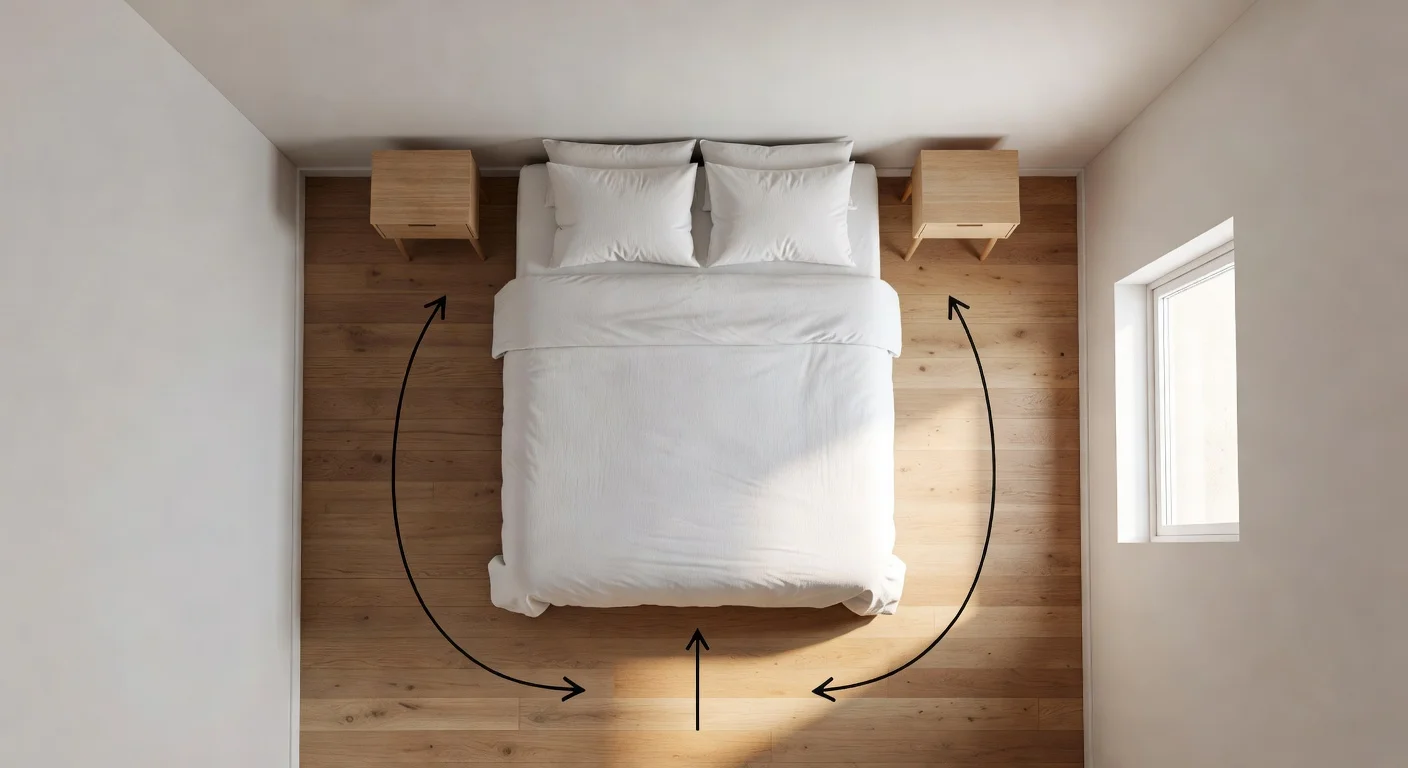
A 10x10 bedroom layout with a queen bed is a floor plan strategy that minimizes walking space to fit a 60-by-80-inch mattress inside a 100-square-foot room. Unlike primary suites that offer vast, empty zones, this footprint requires you to prioritize sleep comfort over large storage furniture.
As someone who maps out tiny apartment floor plans for downtown renters regularly, I see this exact dimensional trap all the time. People buy massive, upholstered bedframes and suddenly realize they cannot open their closet doors.
Designing this room is mathematically strict. You do not have the luxury of guessing.
What are the hard numbers for a 100-square-foot bedroom with a queen bed?
Standard queen mattresses are always 60 inches wide by 80 inches long, consuming a flat 33.3 square feet. That leaves you with roughly 66 square feet of totally empty space, out of which you must carve your walking paths.
If you buy a sleigh bed or a frame with an angled headboard, you easily lose another 4 to 6 inches of floor depth. That pushes the foot of your bed directly into your traffic lane.
The most common mistake I see early in 2026 is buyers ignoring the mattress overhang. Blankets and thick duvets add an extra 2 inches of volume around the perimeter.
How much walking clearance do I actually need?
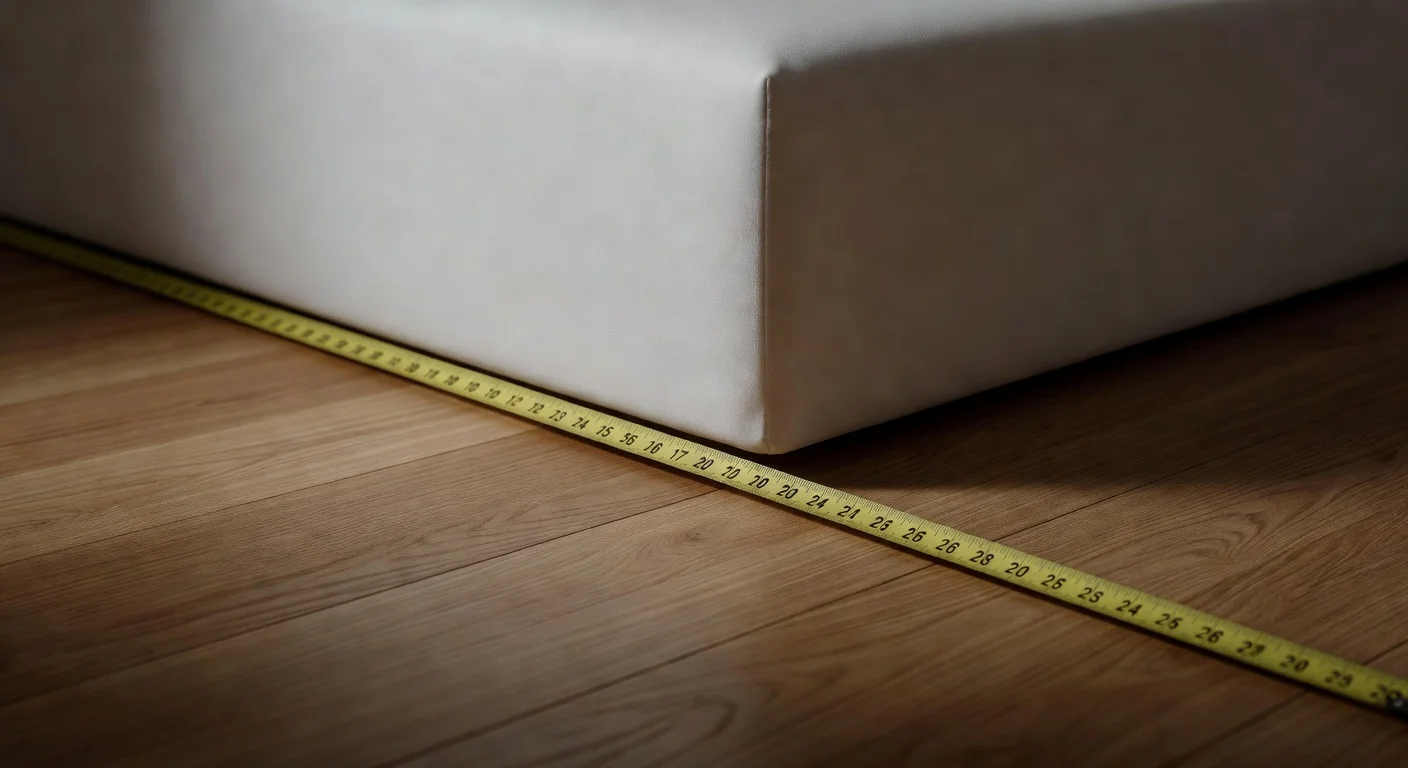
You need an absolute minimum of 24 inches (2 feet) of clear walking space on all three sides of the mattress. If you go any narrower than that, you will bruise your hips on the mattress corners every morning.
The International Residential Code outlines basic safety clearances for egress, but comfort requires strict adherence to the 24-inch rule. If you plan to open a dresser drawer, that number jumps to 36 inches on that specific side.
Will a thick headboard ruin the floor plan?
Yes, thick headboards waste priceless inches in a squarish layout. If your headboard measures 8 inches thick, your remaining clearance at the foot of the bed shrinks to a microscopic 32 inches.
I strongly prefer metal platform beds or direct-to-wall upholstered panels. They steal exactly zero inches from your floor map.
Where should I put a queen bed in a 10x10 room?
You should place the bed dead center on the wall directly opposite the primary bedroom doorway. This establishes visual symmetry when you walk in and provides perfectly equal 30-inch walking paths on both sides of the mattress.
This centrical alignment is the most functional of all room planner bedroom strategies. It anchors the space heavily.
If your opposite wall has a massive window right in the middle, you have to break this rule. In that case, use the longest uninterrupted solid wall instead.
Can I push the bed into the corner to save space?
No, you should never push a queen bed flush against a wall if two adults sleep in the room. The person pinned against the wall will have to physically crawl over their partner just to use the bathroom at 3 AM.
It also makes changing fitted sheets a sweaty, miserable nightmare. You have to lift the heavy mattress while awkwardly kneeling on it just to tuck the corner in.
The only time I break this rule is for independent teenagers or single sleepers. If you are alone, cornering the bed frees up a massive 50-square-foot chunk of space for a desk or gaming setup.
Where exactly do two nightstands fit?
You can fit two nightstands on either side, provided they are strictly 15 to 18 inches wide. You have exactly 30 inches of theoretical space on each side of the mattress, but you cannot fill it completely.
You need a hard buffer zone between the furniture and the wall. Standard bedside tables hover around 24 inches wide, which completely blocks out your walkway.
Here are the best alternatives I currently use:
- Floating shelves: Mount them 30 inches off the floor to keep the ground totally visible.
- C-tables: Slide the base under the bed frame so only the top surface extends outward.
- Headboard storage: Buy a 6-inch deep shelf that sits directly behind your pillows.
How to visualize a 10x10 bedroom layout with a queen bed before buying?
You must simulate the furniture placement digitally before ordering a 200-pound mattress. The traditional method of taping outlines on the carpet is tedious and rarely accounts for vertical bulk.
By late 2025, visualization technology completely bypassed manual drag-and-drop interfaces. Now, interior designers and renters alike rely on smart cameras.
If you want to save yourself a massive headache, test the space first.
Which mock-up tools actually work in 2026?
The best tools range from heavy CAD programs to instant AI photograph renderers. I spent hours testing the biggest names against standard 10x10 dimensions.
Here is the current breakdown of the tools I trust:
| Layout Tool | Core Strength | Price Point | Best Use Case |
|---|---|---|---|
| SketchUp | Down-to-the-millimeter exact architectural modeling. | $119/yr | Technical professionals mapping wall studs. |
| Renova AI | Top pick for instant visual rendering with zero manual effort. | Free trial | Seeing beautiful redesigns instantly via photo. |
| Planner 5D | Dragging basic furniture blocks onto a 2D blank grid. | $19/mo | Outlining raw bird’s-eye floor plans. |
SketchUp is unbeatably precise for contractors, but it takes three weeks to learn. If you just want to know how a Japandi-style queen bed looks in your current room, use Renova AI.
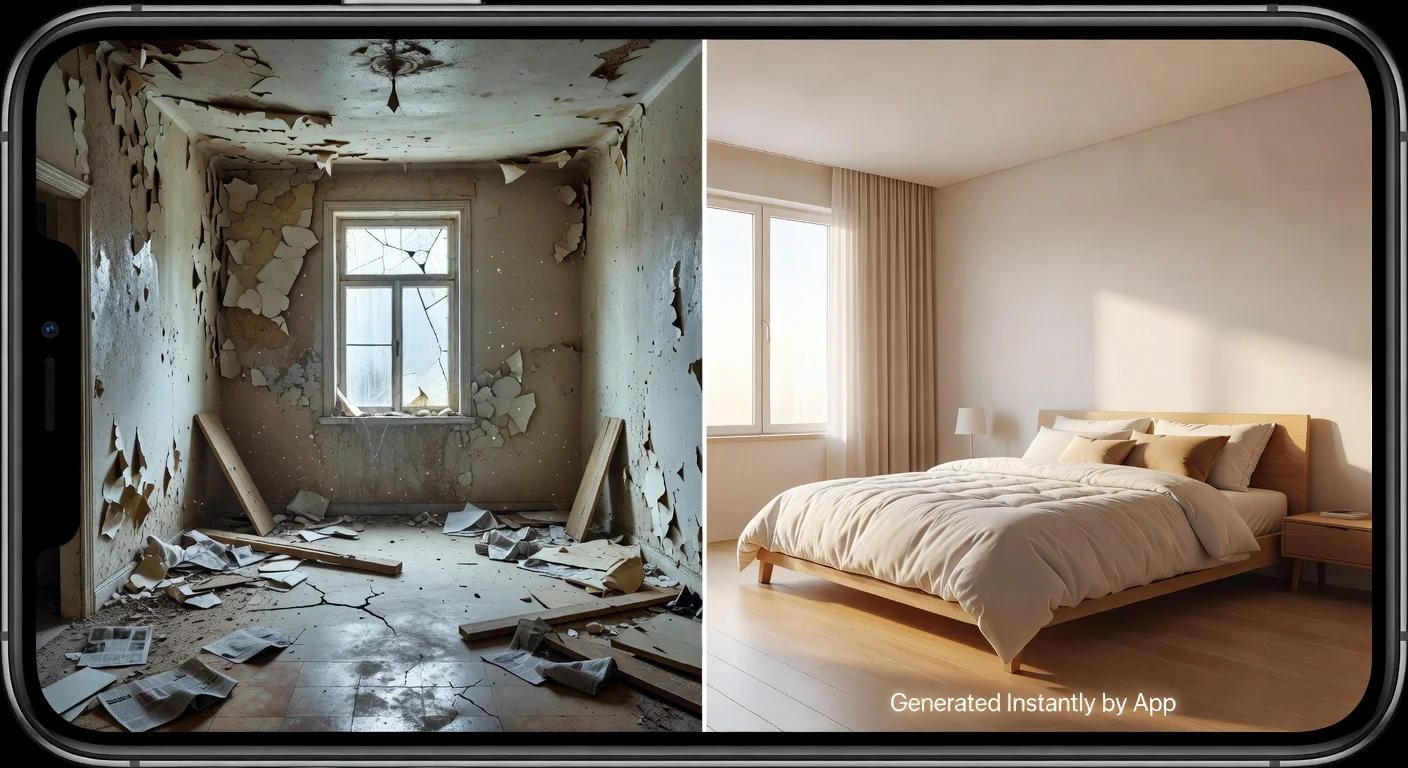
You just snap a picture of your empty bedroom with your phone. The app automatically visualizes the space with a perfectly scaled bed and over 100 style options in seconds.
You do not have to manually edit or drag anything (which honestly saves hours). If you want to grab it, you can find the app on the iOS store.
How to fit dressers and closet doors in a 10x10 bedroom with a queen bed?
You must use tall "Highboy" dressers rather than wide, horizontal ones. A standard 6-drawer dresser is at least 60 inches wide and will choke the room entirely.
A tall lingerie chest or a vertical 5-drawer stack gives you the exact same cubic volume of storage. However, they only eat up 24 inches of linear wall space.
Place this tall dresser near the room's entrance but behind the door's swing arc.
How do closet doors impact the bed space?
Standard swing doors destroy your layout because they demand a 30-inch radius of permanently empty air. If your bed sits too close to the closet, you will smash the door into your duvet every time you reach for a jacket.
If you have the budget, rip those doors off immediately.
Replace them with:
- Bypass sliding doors: They overlap internally and require zero outward clearance.
- Heavy curtains: A ceiling-mounted track hides the closet cheaply and cleanly.
- Bifold doors: They halve the swing radius, stealing only 15 inches of room space.
According to standard home building dimensions, sliding tracks only require a 2-inch floor lip. That is a massive return on investment for small spaces.
Can I put my bed directly against the window?
Yes, you can place the headboard against the window, but you must ensure it has a low profile. Blocking natural light shrinks the room visually, making it feel like a cramped basement.
Choose an airy, metal spindle headboard so the sunlight passes right through the bars. Alternatively, push a flat platform bed up against the sill and use firm Euro pillows instead of a wooden headboard.
If you live in a cold climate, remember that sleeping directly beneath single-pane glass creates a painful draft. Keep your mattress at least 4 inches away from the glass inside older homes.
Frequently Asked Questions
How much walking space do I need around a queen bed?
You need exactly 24 inches of clearance on both sides and the foot of the bed. If you need to open dresser drawers, you must increase that clearance to 36 inches on that specific side.
Will a queen bed fit in a 10x10 bedroom?
Yes, it fits easily, but it consumes 33.3 square feet of the room. This leaves you with roughly 66 square feet for walking paths, a small dresser, and two slim nightstands.
Should I push my queen bed into the corner?
No, you should avoid pushing a queen into the corner for two adults because the person on the wall side gets trapped. It also makes changing the fitted sheets incredibly frustrating.
Can I fit a desk in a 10x10 bedroom with a queen bed?
Yes, but you must sacrifice one of the nightstands. You can place a 30-inch wide floating desk on one side of the bed to serve as both a workspace and a bedside table.
What size rug works best under a queen bed in a 10x10 room?
You should use an 8x10 foot rug placed horizontally underneath the bottom two-thirds of the mattress. This leaves exactly a 12-inch border of exposed floor around the perimeter of the room.
Do sliding closet doors save space in small bedrooms?
Yes, sliding bypass doors require zero outward clearance. Standard swing doors devour up to 30 inches of usable floor space when fully opened.